2.05.2011

beyondwords Archive JLA at CSO 10.28.10

It was an evening of geniuses and rebels that started in Evanston (named after me) and finished in the loop. By the end, I had seen Alex Ross, met John Luther Adams, and gained a new appreciation for Mahler.

[unreservedly recommended!]

At Northwestern, John Luther Adams was there to accept the Nemmers Prize ($100k) and to talk with certified genius Alex Ross. They spoke casually about JLA's biography, Alaskan lifestyle, and the tradition of experimental music in America. Frank Zappa, James Tenney, and Varèse featured prominently, such that when Beethoven surfaced towards the end (in reference to the 9th) it was somewhat of a shock. [Beethoven and JLA share almost nothing but the instruments, though his 9th is his most spacious, Alaskan moment; my roommate's noise band has more in common with JLA's music.]

And then I biked down the lakefront, Chicago's most Alaskan side, to see Adams' Dark Waves at the CSO.

Before the concert, there was a 2-piano version of the piece, which gave an impression but ultimately failed the composer's intention. The tape part and piano part started out sonically fused, but progressively came apart--separate but equal. And, for the size of the hall, the amount of sound didn't fill it up. Like a bass drum in the desert, the sound floated away in the wind. But an impression. An idea of what to expect. [In the middle, I noticed my heartrate was elevated, like 70bpm, from the bike ride down. Maybe I was still moving too fast for the piece at this point?]

The orchestra version that opened the concert succeeded much better and was an otherworldly and meditative experience. However, it reminded me of a piece for solo gong by James Tenney and suffered from the comparison. The Tenney piece was, essentially, written on a notecard and was a gong roll from quasi niente to a billion forte and then back--for twenty minutes. It starts as muddy low tones and becomes gradually brighter as the overtones emerge. Adams' piece was essentially this but with a more undulating terrain: several peaks and valleys, rolling in and out, like, er, waves. But, whereas the Tenney piece is inherently based on the natural properties of sound, Adams uses only the 5th. This works fine in the lower registers to create a pitchless mass of sound, but at some point, the violins come in and ruin it. All of a sudden, as the violins play an oscillating 5th, there are distinct pitches; suddenly, we were no longer drifting in the void, we were in a concert hall listening to music. Which is an interesting experience--going from out there to in here--but was disappointing to me. [I would have liked to see more divisi, like in Ligeti's soundmasses.] That said, the ending was positively dramatic: after 12 minutes of sustained low notes undulating somewhat subconsciously, the sudden and severe absence of sound felt like a interior nuclear implosion.

The program moved from one composer in the wilderness to another: Gustav Mahler. I have never loved Mahler, but these songs, from Des Knaben Wunderhorn, helped warm my cold and jaded heart. The soprano, Canadian Measha Brueggergosman, was a big part of it. In the first two songs, Rheinlegendchen and Verlorne Müh'!, with their waltzing cheerfulness and optimism, she bobbed and swayed, squeezing every drop of meaning from the words and every drop of expression from the music. And so, while these two songs are of Mahler's more saccharine Alpine mood, I found their performance delightful, which is not something I usually want to feel and not something I usually admit. The second pair of songs, Wo die schönen Trompeten blasen and Urlicht, were intimate and somber; Ms. Brueggergosman adjusted her performance accordingly, seemingly more natural and genuine. With Mahler's typical bombast stripped away, Brueggergosman and conductor Jaap van Zweden drew the audience into an interior world of love and heartache. Simple, beautiful, and intense.

Then intermission.

The second half was Shostakovich's sprawling 8th Symphony. Living in and under the U.S.S.R, DSCH was always being manipulated by the apparatchiks to write more uplifting, patriotic music--forced to live in the wilderness of his mind. His international celebrity in 1942, including a picture on the cover of Time, was a result of his 7th Symphony, premiered during the seige of Leningrad by the Nazis. While the 7th has a pretty clear program, the 8th does not, expressing the inexpressible only slightly better than silence. The first movement starts dramatically, like the 5th, and then flows naturally, like the Volga--for nearly 30 minutes. [Some in the audience thought this the whole symphony, and so the first movement received a smattering of applause.] The second and third movements were typical Shostakovich bombast (to which I'm far more partial than to Mahler's). Van Zweden's tempo in the 3rd was dizzyingly fast--exciting and dangerous--like an insane train nearly running off the tracks, nearly blowing the trombone section apart, and causing some disagreement between the low brass and percussion sections. [Seriously, compare: DSCH, OZ] The fourth movement was profoundly resigned and forlorn, like DSCH was giving in to Stalin and his henchmen. The depth of his sorrow found no resolution in the abrupt transition to the final movement: the obligatory happy ending. This came across as rambling and distracted, forced and awkward, and left me feeling small and powerless against life's obstacles.

Thus, in the end, the program works: from the primordial ooze of Adams' Waves to the idyllic childhood of Mahler's songs to the harsh realities of DSCH's 8th. All three are individualist composers, mavericks, and base their art on their immediate environment. Regardless of style, there's an honesty to their work; regardless of technique, they have something important to say and are continuously endeavoring to say it. [In stark contrast to last night.]

beyondwords Archive Fulcrum Point 10.26.10

Bold, brassy, and suave, something alchemical emerged Wednesday night as Fulcrum Point opened it's season at the Harris. Dubbed "Motown Metal", the concert turned the Harris into one big blast furnace, turning disparate pieces of metal into some sort of high-grade steel.

The concert began with Michael Daugherty's Motown Metal--the title track. Yesterday, in my preview, I called Daugherty a "gimmicky" composer. This piece reminded me: he's also "kitschy". Every one of his pieces that I know has a program that is based on something distinctly American: Superman, Elvis, the auto industry. Based on the title and program notes, I expected some tone painting, making reference to "muscle cars" and "assembly lines". These only came through vaguely. Instead of representing tons of Detroit steel, it had about all the weight of a Smart Car--a sort of fanfare for car-loving Americans. Lots of craft, little inspiration: he must have many commissions. (3.9 / 10) [I could tell that the skill of the ensemble, brass under the direction of Stephen Burns, greatly exceeded what the piece required: it was like watching Mario Andretti drive a Chevy Nova.]

Next was a piece by Bang on a Can composer David Lang: the anvil chorus. Lang wanted to go back to the early days of percussion, when it was just repeated banging, like on metal to make stuff. Showing his minimalist roots, Lang's piece is based on shifting numerical patterns, related more by multiplication than addition. For a brief moment in the middle, it gets pretty cool; the opening patterns return triumphantly and are supported by a quirky, almost toe-tappable beat. And then it goes back to just being abstract patterns--albeit interestingly polyrhythmic. (4.5 / 10) Another solid gold performance: Jeff Handley (dressing the part in blacksmith's apron) and Tina Laughlin made it look easy [though I don't think the audience needed an explanation why Handley was in costume].

Finally in the 3rd piece, the fulcrum, things got revved up. Stephen Burns, Fulcrum Point's Artistic Director, played, Metallics, a solo trumpet piece with electronics by Yan Maresz. While many piece with electronics will either play a pre-recorded track or use computer-based effects, this piece seemed to do both. The logistics, though still somewhat of a mystery, were flawlessly executed by composer and performer alike; the quality of the sound coming through the speakers seemed higher definition than many similar pieces and were both ear-catching and intriguing. The spatialized reverberations and other assorted manipulations bounced around the room as Burns pulled out various mutes and extended techniques, becoming a medium through which the music flowed rather than just a performer. I would gladly see this piece again. [And you have the chance to at Fulcrum Point's next concert in early November.] (7.2 / 10)

Then, a quintet of the Fulcrum brass hammered out Stefan Freund's Metal. The three movement work was on the verge of momentum failure during the first movement, on the verge of film score in the second, and tried too hard in the third. In the first, I had the sneaking suspicion that he composed it on the computer with Finale or Sibelius; much of the rhythmic drive was completely dependent on one person playing at exactly the right time and at the right volume. The Fulcrum Pointers seemed as polished as ever, and yet the momentum of the music kept fizzling out. The second movement was like from a funeral scene in the Middle Ages but with wrong notes thrown in so you know it's contemporary. Just like Prokofiev always said, if you find yourself writing music that is too earnest and pretty, just smudge some of the notes around so people know you're being ironic. Overall, a pretty good piece for a doctoral candidate. (4.9 / 10)

To close, Chicago got to hear yet another piece by Mark Anthony Turnage: Out of Black Dust. Similar to how he Beyoncé, Turnage takes inspiration from a Classic Led Zeppelin tune and uses it for much of the melodic content. But it's always a little off or in parallel seconds--gotta be ironic. It's high energy and loud--not a terrible way to finish. And at least, afterwards, no one will ever say "More cowbell". [8 of them playing in unison is the best compositional idea evar.]
(5.6 / 10)

Once again, the success of Fulcrum Point's programming is in the metallurgy more than in individual pieces. Whereas many Chicago area new music groups focus on a style, location, or composer, FP's program slices the new music pie in a different direction. Again I noticed that the crowd is not your typical new music crowd, only recognizing 3 familiar faces: Stacy Garrop, George Flynn, and Janice Misurell-Mitchell--all Chicago-based composers. The audience seems to be attracted by the welding of music to extramusical references to mainstream culture.

Come for the intersection of culture, stay for the beer. To celebrate the Motor City, the reception included Stroh's, which I had never actually had [though my parents' friends were down with it]. I almost didn't indulge but figured it was the perfect opportunity to try it. Not terrible, but I think I'll stick to PBR just for its cachet.

beyondwords Archive Voxare 10.25.10

Sometimes, when a concert has but 20 people, I feel disappointed by the turnout. Last night, at High Concept Laboratories, with the same number of people, it felt intimate--like I was invited to a house concert in an abandoned industrial space.

The event was the Voxare String Quartet providing accompaniment to Dziga Vertov's 1929 classic silent film, Man with a Movie Camera.

And they're doing the event again tonight in case you missed the invite: Highly Recommended.

[Never mind the fact that I left feeling slightly nauseated.* That's part of the experience!]

The music was selected by Voxare from Russian/Soviet composers of the 20th century, a responsibility they did not take lightly, resulting in a stunning symbiosis of sound and image. And the execution was just as good: the quartet played with one voice, showcasing effortless technique and fevered intensity. I would be excited to see them without the pretense of a film.

If you're interested in going, visit High Concept Laboratories and RSVP to: info AT highconceptlaboratories DOT com. The show starts at 7 and is $10 suggestive donation.

The music had an interesting effect on my perception of the film; the muted aggression of Shostakovich, the wrong-note neo-classicism of Prokofiev, the expressionless ostinatos of Stravinsky, and the surreal futurism of Mosolov gave the image a certain gravitas that cemented the preconceived notions we may have of the Soviet Union. It's one interpretation, just like the Cinematic Orchestra had a vastly different one.

* - About partway through the film, I did start to feel some sort of "Blair Witch Effect". I had read that the fast cuts and sheer amount of edits (~18,000) was overwhelming for audiences of the time but figured my modern eyes could handle it. Alas, I don't watch T.V. like I used to--but when I do, it's often South Park. Apparently, I can handle it for 22 minutes but not 80. The slight nausea had a sort of "Clockwork Orange Effect" and made the day in Soviet life seem horribly oppressive.
Lyric's current production of the Bizet's über-Classic Carmen is straightforward and to the point but with an underwhelming amount of charisma and chemistry. [See it now through October 29, then again (new cast) in March.]

Bizet's classic opera proves itself timeless (unlike certain other operas this season), surrounding and connecting the instantly recognizable tunes with unassumingly beautiful music: nothing mundane, no excess. And while Macbeth suffered the fate of a dramatic-turned-comic, Carmen is rather a comic-turned-dramatic: its more serious music and the tragic ending is a mix that feels more realistic. [Even Nietzsche said it "displaced all the fog of the Wagnerian ideal."]

Lyric's production is a panoply of succulent voices, though it takes more than a pretty voice or two to make an opera work. Unfortunately, selling the story to the audience comes up a bit short.

Most noticeably, there's no amorous effusions. Carmen (last-minute fill-in Katharine Goeldner) is underplayed and, though exuding confidence and élan, does not muster up much sensuality. She's flirty, but more like an older aunt, less like a lover. I thought to myself: "you're still living the gypsy lifestyle? Isn't it about time you grow up and buy a condo?" [but perhaps that was directed more at myself...]

Yonghoon Lee (Don José) doesn't meet her halfway, so the murderous passions at the end erupt as if from a long-dormant volcano. Though I didn't love presence on the stage--barely believable as a Mediterranean lover--I enjoyed hearing him. While his body was stiff and actions contrived, his voice emerged from his awkwardly gaping mouth like Cain and Ebel from a firehose--a compliment, I assure you. HIs performance made Don José into a geeky mamma's boy, in the end falling victim more to his own naiveté than his hot-headed nature.

[I think future performances would be better with a few shots of Cuarenta y tres between the two leads before/during the show.]

If the leads were a couple of boobs, the supporting cast was a diamond-in-the-rough-studded brassiere. Kyle Ketelsen's Escamillo and Elaine Alvarez's Micaëla were nearly in danger of upstaging the leads; whether it was Ketelsen's swaggering chutzpah or Alvarez's virginal tenderness, both appeared more fully formed and human than the two ill-fated lovers. Ketelsen was, as usual, fun to watch and a delight to hear; Alvarez's voice, a new one to me, gushed with expression and lyricism.

The performance I saw was a Wednesday matinée, so I finally got to see who goes to matinées in the middle of the workweek: mostly retired people. So, if the audience reaction was off-puttingly tepid, this is, mayhap, the reason. Still, Mr. Lee got heaps of bravos at the final curtain call, probably an enthusiastic hoot or holler from just about everyone who didn't make a mad dash to the exit at the orchestra's final notes.

Final Notes:
Harry Silverstein's direction made for a bone-chilling ending. I was reminded that this is (in addition to Breast Cancer Awareness Month) also Domestic Violence Awareness Month and thought of the unnecessary murders that have happened recently--specifically, the lacrosse player who killed his ex-girlfriend. Perhaps we could use the tragedy on stage to remember the tragedy happening ever day; perhaps at the end, volunteers could collect donations for domestic violence shelters. Breast cancer seems to get all the attention in October--perhaps because it's curable. Maybe domestic violence, like poverty, is deeply embedded in the culture, but culture can and does change--but only little by little over decades and decades.

Recommendedish: Great music but don't bother splurging on expensive seats

Want a second opinion? Try Andrew Patner. See if I care.

beyondwords Archive dal niente 10.13.10

dal niente is back in town and better than ever. The ensemble was invited to Darmstadt this summer where they won the Stipiendienpreise, which roughly translates to "most badass ensemble prize".
Wednesday night, they were at the Mayne Stage, giving me my second opportunity to scope out the venue in as many weeks. I approve. Having seen post-Classical experimental Art Music in bars before, I knew it could fail. I was skeptical Wednesday when I didn't see a massive amount of microphones to combat the sound-dampening fixtures. But there was no need; the sound throughout the evening was ample, not D.O.A.--a neutral space with little added resonance or reverb.

The evening was broken up into two sets, the first skewing more American, the second more Euro. Musically, the ensemble was fantastic in every piece, though the expressive quality was often hampered by the head-down effort at precision. [Not that most of the pieces required much expression.]

The standout loser of the evening was Nico Muhly (MYU-lee), whose piece How About Now was rescued from the trash bin of history and given a second chance. Muhly wrote the piece in 2006, when he was a fresh 25 years old; he may be a boy wonder now, but this piece sounded young, like he had just discovered Steve Reich, like he had sketched out a couple Reich-esque ideas, ate them for lunch, and then threw them up on the page. The ideas weren't terrible, but the whole was flimsy. His work often verges on falling apart, but this one never got put together. It alluded that it had somewhere to go but then never fulfilled its promise; its fits and starts made it both too unpredictable and predictable at the same time. No one should ever program this. Ever. [...but I'm sure if we heard him talk about it, we'd find him charming and endearing and therefore über-talented.]

It's easier to harshly criticize than to mete out praise--especially when tired. Muhly's piece was the only one that made me angry; now that I've gotten that out of the way, I can be more delicate. It helps to have slept a couple nights.

The stand-out winner from the evening was Shanna Gutierrez in her performance of Michel van der Aa's Rekindle (apparently not a reference to the Amazon product). The piece was above average (7.0 / 10), with interesting sound design, sophisticated integration of live flute with prerecorded track, and a good sense of motion and flow. And, while I generally am not impressed by show pieces, this piece had a virtuosic component (that never overtook the focus), which Gutierrez served up with grace and intensity. The piece was successful for long stretches, inducing a mesmerization only periodically interrupted. At the end, Gutierrez gave a smile and a little laugh, as if she felt both triumphant and relieved--an apt mixture of feelings.

[Interesting aside: Ms. Gutierrez first "met" Mr. van der Aa through Twitter, through which she both learned about the world première of Rekindle and inquired about performing the US première. Technology rocks.]

Nearly a week after the concert, I have some lasting impressions about the other pieces:At 2.5 hours (including intermission), the concert was just a bit much. Listening to new music (anything unfamiliar) taxes mental muscles like speaking in a foreign language. After 5 difficult and thorny pieces on the first half, the singular beer I had at intermission, and a long day, I was sapped for the second half. In hindsight, a lot of the pieces sort of run together.
That being said, here are some further recollections.Set 1:

The Cheung, Brown, and Balter pieces all fit well together, the van der Aa being the exception that proves the rule, and the Muhly being somewhat out of left field.

  • Centripedalocity by Anthony Cheung
Once, in grad school, I titled an orchestra piece "Pyroxialisticalityness". Cheung's title strikes me as similarly ridiculous. And the music sounds how the title looks: filled to the brim, tamped down, and filled again--a sort of minimalist maximalism. I have had the scene from Amadeus in my mind with Cheung as the young Mozart and me as the doddering Emperor: "too many notes". Perhaps history will judge me like it did the Emperor and in 200 years, but perhaps the Emperor has no clothes. (4.6 / 10)

  • Growth by Marcos Balter
If Cheung's piece was maximalist minimalism, then Balter's piece was maximalist minimalism: repetitive but not trance-inducing, a quizzical mix of movement and stasis. Like the title suggests, the piece proceeded logically and organically with well-timed interruptions--just like life should be. A good piece I wish I could remember more: (7.2 / 10)

  • Uneasy by Eliza Brown
Ms. Brown is a doctoral candidate at Northwestern, and, though her music exhibits a high degree of polish and craft, it uses a rather generic academic language that makes it difficult to distinguish from the other pieces. Most memorably, the piece explored the very high and low registers of the ensemble, resulting a unique and beautiful sonority. (4.2 / 10)

Set 2:
The second half was a slow blur of scrapes, grunts, and squeaks, wonderfully organized and orchestrated. Along with the halftime Half Acre, it induced a sort of meditative daze, an subtle reverie of abstraction.

There's another dal niente concert next week. Stay tuned for details.

[addendum: How many of these composers are/were affiliated with Northwestern? Yet again, I joined all the wrong secret societies...]

beyondwords Archive Macbeth at Lyric 10.6.10

Lyric's production of Verdi's Macbeth was not a total tragedy, managing to combine a tragic plot, rousing choruses, and circus aerials into a production worthy of half the audience standingly ovating.

For me, the performance induced cognitive dissonance. Verdi's opera, like Shakespeare's play, takes place in Scotland, though you wouldn't know it by the music, the language, the costumes, or the set. The only things Scottish were Macbeth's Braveheart locks, the hand-forearm shake, and the Macallan 12 I had at intermission. You know what they say about all things not Scottish.

In fact, nothing seemed to go together. The sets and the costumes seemed to be borrowed from a troupe of androids from the future trying to imagine medieval Scotland. Though Verdi broke ground by writing an opera that wasn't a love story, he neglected to change the music; Lady Macbeth's Act I aria about conjuring the demons of hell shouldn't sound like she's falling in love.

Singers:
Thomas Hampson (Macbeth) had a voice to suit the part: strong yet vulnerable, attractive yet not all that pretty. Nadja Michael (Lady Macbeth) drove her husband to kill and nearly did the same to me. Her first act arias proved her ability to sing "like a banshee" while slinking around and writhing like
Gozer, the destructor. She's one you either love or hate, and for me, unfortunately, I loathed having her on stage, flaunting her hot bod and wailing hysterically. [For her curtain call, nearly half the audience stood.] Perhaps it was just a matter of proximity: my seat was relatively close to the stage, whereas Ms. Michael was playing--not just to the back of the room--but to somewhere downstate. All that being said, her Act IV aria was bone-chillingly haunting; I finally felt sympathetic to her character, whom I had been killing off in my head since the beginning.

The supporting cast nearly eclipsed the leads. Stefan Kocán (Banquo) played one of the few likable characters, singing with a sound like a rich string bass. Leonardo Capalbo (Macduff) had a more traditional Italian tenor sound, like butter dripping off a hot biscuit.

The chorus and orchestra never cease to amaze me and were in their usual top form; Renato Palumbo coaxed out a very sensitive, lyrical overture from the pit and, conversely, rhythmic precision from the singers.

From the Galley
Macbeth
dates from Verdi's "galley years", in which he toiled endlessly only to produce a few operas the public still hears. We here in Chicago were blessed last year with Ernani--and I do mean "blessed" (in the way a religious couple describes an unplanned pregnancy); this year, we get Macbeth, which reminded me of my vow to avoid the first half of Verdi's output. [I was much happier with Macbeth than Ernani but have labored enough in Verdi's galley.]

And, for the first time, I feel like the Lyric production misinterprets the score. While Shakespeare's work is dark and heavy, Verdi's is surprisingly light--inappropriately so, but so it is. There were moments in the libretto and the music that deserved more comedy but were played dramatically serious on stage, resulting in too many mixed messages with nothing to say.

beyondwords Archive MusicNOW: 10.4.10

The Chicago Symphony Orchestra is an institution. And it always makes me happy when institutions get it right. Which they can only do when pressured by smaller, more nimble and agile organizations. And so the work by ensembles like eighth blackbird, Fulcrum Point, and dal niente has finally had a positive effect on the CSO, Chicago's most venerable Classical music institution, which presented its new music series, MusicNOW, on Monday at the Harris.
[Writing about Contemporary Music requires a great attention to capitalization.]

Unless you've been under Iraq, you've heard about Maestro Muti's coming and subsequent early withdrawal, but receiving a lot less press and fevered googling is the MusicNOW series which, quietly, unassumingly, and flawlessly opened Monday night at the Harris.

Nevertheless, the Harris was packed with more people than I've ever seen at a new music concert--all the usual suspects and many more.

The evening opened with Mason Bates and Anna Clyne, the composers in residence at the CSO, introducing the evening with their respective West coast and British mannerisms--Bates appropriately tan, Clyne predictably not.

Li Po
As a continuing celebration of Mexico's independence, the program included pieces by 2 Mexican composers, of which Li Po by Enrico Chapela opened the concert. Chapela based the music on a Mexican poem about the Chinese poet Li Po and so included projections of the poem--in hand-made caligraphy--onto a screen behind the performers. The piece for chamber symphony and tape fused the two media symbiotically, which, like a happy marriage, were sometimes independent, sometimes joined at the hip. About 50% of the sounds on the tape part sounded rich and lush, electronic but acoustic, on the Harris's sound system; the other 50% sounded cheaper and more digital. The form of the piece, based on the structure of the poem, was indecipherable, for the poem itself was enigmatic and was in Spanish with no subtitles. Even if I spoke flawless Spanish, each verse of the poem flashed on the screen for a mere 5 or 10 seconds, not long enough to engage the imagery. And even if I had more time, the music drew most of my attention with its polyrhythmic activity and spatialized tape part. Overall, a good piece--not amazing. It didn't piss me off or insult me (except for the "seagulls" in the violins) and had plenty going on to keep me from getting bored. (6.5 / 10)

Vision Mantra
After the Chapela was a piece for string trio, Vision Mantra, by local composer Marcos Balter--local in that he lives in Chicago and teaches at Columbia College. The piece was repetitive, rhythmic, and slow to change: minimalist. But it was minimalist in a different way. Instead of trance-inducingly constant, it was broken up into short phrases, each of which being either a perfect copy or a slight modification. The pauses between each phrase allowed the audience to clearly hear each phrase with no distractive connective tissue. But after awhile, it got old. Instead of inducing a meditative calm with a heightened sensitivity to subtle changes, I started to get irritated by the regularity: each phrase was the same perceptual length.

It was during this piece that my attention was drawn to the amplification: each piece was amplified, and while for the pieces involving a tape part, this was absolutely necessary (and perfectly mixed), for the acoustic pieces it was less necessary. In this piece, the amplification caused the grating of the bow on the strings to be more prominent than if it were unamplified. And thus the subtle beauty of the piece was further disturbed.

Within the whole of the concert, the piece acted as a nice sorbet to the electronic-laden pieces around it. But on its own, it was a one-timer: (4.5 / 10)

steelworks
The Wednesday of the 5-piece concert was Anna Clyne's steelworks, which was the popular favorite. The piece was about the steel industry and was accompanied by a video by Luke DuBois. There were only three performers, but with the tape part and video, it was an all-encompassing experience. The trick, Clyne was clever enough to realize, was to keep the components simple to let the complexity build up. Her writing for each member of the trio--percussion (mostly marimba and bass drum), bass clarinet, and flute--was fairly simple with only brief moments of "look-at-me" attention-grabbing--tasteful and subdued. And the tape part cradled the instruments nicely, turning a mere trio into something that felt more chamber symphony. Clyne seems to succeed in the big picture even when working with somewhat mundane details. Worth another listen/viewing. (7.5 / 10)

Bhairav
After Anna Clyne's work filled our every mental orifice, it was a welcome break to have Ana Lara's Bhairav, a completely innocuous piece for string quartet that, much like Balter's string trio, functioned very well as a sort of aural sorbet. The first third of the piece used shimmering tremolos in the upper strings to accompany a very run-of-the-mill, elegiac chant in the cello. The tune moved up through the viola and then to each of the violins. This took all too long, proceeding slowly and predictably. Suddenly, and with no apparent reason, the second half took off with a driving rhythmic homage to either Shostakovich or Bartòk. Those with less experienced ears could call it a favorite; those with jaded and overtrained ears could hear the thieving and called it "embarrassing." And, there were no program notes, no explanation before the piece, so the meaning of the piece, something that might have distracted us from its simplicity, remained an enigma. I was content to hear it once--but just once--but kept wishing I were hearing one of Schnittke's string quartets. [Apparently, I missed a sixth of the piece somewhere: lost to the ether.] (3.5 / 10)

Digital Looms
My first reaction to Mason Bates' closing piece was against the title: using "digital" in a title sounds cheesy. And since the piece was for pipe organ (yes, like the one in the church, not a B3) it had an uphill battle to prove that it wasn't straight out of the Mars Cheese Castle. As soon as it started, though, my fears were allayed; the opening movement had nothing schmaltzy about it, instead playing it cool, like a DJ spinning at a cool underground-loft-art-gallery. This progressed and flowed into the second movement, Fanfare with Breaks, which was like spastic, Keith Emerson-esque, organ dogfighting against Amen breaking all over the place. Not quite cheesy but it had its moments. After the third movement, things get a little fuzzy for me (it's also been a couple days). I remember the 4th movement, Geraldine's Parlour, because of the vibrato, self-consciously feeding the audience one big cheese ball.

I felt engaged while watching it, but now I'm not so sure of its merits. If there's one thing that Bates is good at, it's the moments; if there's one thing he's still working on, it's tying it all together. Each moment is beautiful, interesting or some quizzical combination, but the whole is less than the sum of the parts--just the opposite of Anna Clyne's piece.

Also, judging by Bates' music that I've heard so far, and this piece in particular, I find that his stylistic palate for each piece is too glutinous. He presents enough styles for an entire concert, so when his work comes at the end of the concert, it feels like stylistic overload. Now that we can do anything, do we throw everything into each piece? I say: "Say no to say yes." Save some styles for future work and develop the ideas you have further.

That being said, I would hear his piece once or twice more. Not destined to be a classic, it's both attention-grabbing and holding--a journey through a land of many cultures . (6.75 / 10)

It looks like Bates' and Clyne's music got my highest marks, which brings up a good question: did Mason and Anna choose the other pieces to make their own look good or was it pure accident?

3.11.2010

goings-on: chicago

Lots going on this weekend in Chicago:
  • Friday night you could go to Chicago Opera Vanguard's (COV) fully-staged Winterreise
  • Saturday night you could join me at Corey Dargel with ICE (or go to COV)
  • Sunday you could join me at COV
  • Monday you could join me at MusicNOW to see J. Luther Adams and Golijov
  • Wednesday you could join me at ACM's Sound of Silent Film
I'm mostly posting to my ChicagoNOW blog, so be sure to bookmark it if you want to keep up with Classical music goings-on in Chicago. Not intended to be as critical, it's more about solid performances that would be accessible for new and seasoned audiences. So less Webern marathons and more Short Rides in Fast Machines.


John Luther Adams

2.19.2010

etc. etc. etc.

It is what you call it. But call it how it is. A history to every word, a legacy of associations dredged up, subconscious understanding, a poem behind every word.

Knowledge through experience - layered, woven - makes a tapestry.

Every time you read it or say it, it makes another copy in your brain.


The car's on fire and there's no driver at the wheel
And the sewers are all muddied with a thousand lonely suicides
And a dark wind blows
The government is corrupt
And we're on so many drugs
With the radio on and the curtains drawn

We're trapped in the belly of this horrible machine
And the machine is bleeding to death


Every time you read it or say it, it makes another copy in your brain.

"Donner la liberté au monde par la force est une étrange entreprise pleine de chances mauvaises. En la donnant, on la retire."

Every time you read it or say it, it makes another copy in your brain.


Cut through the associations; separate the wheat from the chaff; unweave the tapestry. Deconstruct. Call it how it is. Who decides?

Freiheit nur für die Anhänger der Regierung, nur für Mitglieder einer Partei - mögen sie noch so zahlreich sein - ist keine Freiheit.


We're in dialogue. I'm talking to you. You are understanding the words I am saying. Now you are speaking; I am listening. I hear words; I hear you. Now you are done talking, and I am dreaming.

opera: "a combination of music and drama wherein the music is not in place simply as background or mood setting, but is given an expressive and communicative platform at least equal to that of the text or stage action."


opera: "an art form in which singers and musicians perform a dramatic work combining text (called a libretto) and musical score."


I didn't know who she was. I had no idea. I had so much to learn. She faded into and then emerged from the static of history like a ghost. Like the King of Siam. She died before I was born.


And I know they buried her body with others
Her sister and mother and 500 families
And will she remember me 50 years later
I wished I could save her in
some sort of time machine
Know all your enemies
We know who our enemies are
Know all your enemies
We know who our enemies are


...usw...

2.15.2010

Wagner's Ring Digest

Last weekend, I saw a 6-hour version of Wagner's Ring cycle. It's not so hard to do if you reduce the singing to speaking, turning each opera into one of four acts of a play. Just like seeing one of the operas, there were two 10-minute intermissions and one 45-minute dinner break.

I would highly recommend checking it out at the Building Stage. It made the entirety of the story manageable, giving the audience a great introduction/refresher, a great preparation for seeing any one of the operas and knowing how it fits into the story.

The question that should be burning in your mind regards the music. How does one make use of the sixteen hours of Wagner's scores?


Before going to the play(s), I read that the ubiquitous composer Kevin O'Donnell had created a score that mimicked Wagner's harmonic changes. In principle, before seeing the play, I agreed with this idea, but in practice, after seeing the play, I found that the composer didn't quite quite hit his aim. That is, it was a good idea but poorly executed. Not simply in the details, the fault lay in some of the early choices.

The problem with the music starts with the chosen style. O'Donnell's score was minimalist rock with a hint of 50s lounge/surf guitar. Which could have been a good choice if the tone of the play was similarly campy. The play, however, treated the epic like an epic, almost highlighting the parallels between the Lord of the Rings saga still fresh in people's minds. There was nothing campy or ironic about the direction, making the music the misfit. The website of the Building Stage described the play as: "not an opera, a play that rocks." Perhaps the misguided decision was not made by Mr. O'Donnell but by the play's director who wanted the style of the play and the style of the music to be somewhat at odds, complementary perhaps.

Once the choice of the style and ensemble were made, O'Donnell was bound to the two guitars, two drum sets, bass, and glockenspiel. Nothing in the ensemble could mimic Wagner's heroic horns or swelling strings, nor did they try. The music was interstitial and necessarily minimalist. There were only a handful of different pieces, most of which referring to the famous and cliched Ride of the Valkyries, that recurred between scenes. Aside from the Valkyrie music, the other pieces referred to the Rhein music and "Curse" leitmotif of Wagner's score. Limiting the references to the score to a few seems both prudent and necessary. The audience, in this case, did not come to hear music in the form of a dictionary of leitmotifs. There are only so many themes a person can take in and remember in this abridged version.

One thing that this production didn't attempt, which I would have liked to see, was underscoring. Wagner's music doesn't just serve the plot, it serves to create an emotional contour, eliciting a connection and reaction. It would be difficult to do (correctly without being overtly cinematic), but subtly using Wagner's trove of music to underscore the more emotionally charged scenes would strengthen the productions coherence and message.

Overall, I was confused by the relationship between the stage and the pit. The acting seemed to be almost Shakespearean: a good balance of dramatic, sentimental, a touch of comedy, and an overall epic quality. The ingenuity with puppets, shadows, and props matched and enhanced that balance. The music seemed unsuited to the spirit of the play. In some cases, it undercut the drama of the scene; in others it was simply unconvincing - paling in comparison to the strength of the acting. Fortunately, this production, unlike a Wagner opera, does not lean so heavily on the music, so the music is merely an unsightly blemish on an otherwise heroic visage.

~ ~ ~ ~ ~ ~ ~ ~ ~

[After seeing the play, to learn and refresh my memory of Wagner's quadrilogy, I learned a lot from this website, explaining the plot and providing a catalog of the leitmotifs. I would have liked to know them better before seeing the play so as to judge even better old and new.]

1.13.2010

unfolding the drama

In a recent discussion, I found myself defending Bartók's Duke Bluebeard's Castle to accusations that it was predictable. In the opera, there are seven doors behind which seven horrible/astonishing mysteries await the Duke's new bride. An easy story to follow: door #1, music, door #2, music, etc etc. It sounds a lot like Let's Make a Deal, but the effect is exactly the opposite: the drama in Let's Make a Deal is in the opening of the doors; the drama in Duke Bluebeard is in the music. If you watch Let's Make a Deal expecting great music, you'll be disappointed; likewise if you go to Duke Bluebeard expecting her to open doors out of order--or maybe she should simply quit after opening the door with all the blood-soaked jewels.


The issue, then, is not a lack of drama but a different type of drama. I started by thinking that the problem with opera is that they are composed by musicians, not playwrights, who may or may not understand theater as well as they understand music. But the problem is probably even larger: music is not narrative (no matter how much people try) and so unfolds in a different way and at a different rate than theatrical drama.

The music underlying 19th century opera is an effort to speak the language of emotions, which seem to take longer to stimulate, foster, and bring to climax. Intellectually, we can understand the intricacies of a dramatic situation without our emotions getting initiated. And so there are redundancies in the plot so that it makes sense musically.

Also, music and language function in a fundamentally different way. Music, especially of the 19th century, thrives on repetition and variation; since there is no concrete information, repetition is not abhorred (except by those who use information theory to understand music, starting with Schoenberg.) Language is generally full of information and so can be much more linear, eschewing repetition.

This conflict of parallel languages telling the same story is the reason behind this parody:


Why is opera so boring?
It's a common concern among those of you who are not opera fans. There are a lot of answers to this question. I would bet that, for most people, they expect a compelling plot, one that rivals what we've seen in movies for the last 50 years. The plots in operas are ridiculous, redundant, and over-the-top. Fortunately, the plot is mostly a vehicle for the music, a guide for our emotions that, hopefully, get stirred by the composer's craft.

Maybe someone should write a mash-up of Let's Make a Deal with Duke Bluebeard. Maybe with some audience participation.


Wait, wait, there's more.
While writing the post, I discovered the following. Synchronicity.


The Colbert ReportMon - Thurs 11:30pm / 10:30c
We Are at War - Philip Glass
www.colbertnation.com
Colbert Report Full EpisodesPolitical HumorEconomy

1.11.2010

A musing on recording and pornography

Humanity has had a libidinous fascination with mirrors since we first set eyes on ourselves in reflective pools of water. The pools allowed us to observe ourselves from the outside, leading to or furthering self-consciousness. But the pools weren't portable, so early humans invented a copy of the pool—the mirror. The mirror, then, is a copy of an object producing a facsimile.

Art
But we didn't stop with simply making the mirror; soon we were creating the images ourselves—all sorts of metaphorical mirrors. We invented artificial forms of representations of our reality (including aspects of our selves), shortening the word “artifice” to make art. Art, then, is a tool: a reflection of facets of the human experience in our never-ending quest to achieve self-awareness. We'll never achieve a reflection the entirety of what it means to be human, so each piece of art is a representation of a more-or-less manageable chunk, with which we can build, over a lifetime, a mental picture of who we are and where we fit in the universe.

Music
Two of the many competing theories surrounding music's origins are that it came either from humans imitating bird sounds or from imitating natural rhythms—heartbeats, footsteps, etc. Or maybe it grew out of speech as song. But somehow these various origins came together to form what we have today: a system that seems to imitate the various forms of human communication through artificially organizing sounds in time. [Or, thinking of Cage, artificially creating an environment in which a mass of people attentively listens to sounds in time.]

And, in the beginning and for many thousands of years after, all that we knew of this art of sound was through live performance. There must have been something communal and magical about the experience, judging by how much music gets entangled with religion. But those days have been going away for the last 100 years. These days, the primary way we interact with music is through recording.

Recording
In the mid-19th century, there were technological developments that allowed people to transmit and record sound waves. When Marcel Proust could no longer go to the opera, they set up a sort of telephone system by which he could listen over the wires—just one step removed from the performance. As the technology increased, we got more and more removed from the original. Soon we had the phonograph, which allowed people to reproduce live performances in their homes. Then, they were no longer “live” performances but done in the studio, allowing for multiple takes. Then, the advent of tape allowed performers to splice together parts of performances to create a more “perfect” recording—one that never existed in reality. At first, this meant that performers could simply polish their performances, but in the 1960s, this grew to mean that the recording could be something that never did or could exist in the real world—a simulacrum. (I'm thinking specifically of Pet Sounds, Sgt. Pepper's and such.) Perhaps it was the impossibility of living up to their unachievable perfection that led the Beatles to stop performing. Even if not, there is something symbolic in their retreat into the recording studio.

Recordings went from being a substitute to the definitive document. Somehow, the copy has trumped the original. This leads to performers feeling pressure to recreate their albums as perfectly in live performance, the pressure leading to lip-syncing and other such atrocities.

Pornography
In these days of the internet, there seems to be a parallel between recorded music and pornography. Humanity has long created images of a sexual nature, and those images, with technological advances, became so “realistic” that they were able to replace the original. It is easier to see the evil in pornography; the act starts as a sacred act of communion and becomes solitary act of debasement and objectification. I see the same problem in recording. With the majority of internet traffic being porn and recordings, the users of the internet are apparently addicted to the copies several generations removed from reality.

Performance
The issue that I have is with how these copies interfere with our “real” experiences. When I am at a concert, I don't want to compare what's happening live to the more “perfect” version I have on CD. I don't find value in automaton performers or, worse, fakery like lip-syncing. I want to see an authentic performance and experience it as such. I want it to be a unique experience, a communion between performer and audience. When the French go to a concert, they use the word “assister.” The experience exists because of the give and take to and from the stage. The audience is just as important as the performer. Otherwise, there would be no performance.

Maybe the Zen masters need to ask us: “If a performer performs to an empty hall, is it still a performance?” At least it's real.

12.23.2009

one buttock playing

Some people want to teach the world to sing. I want to teach the world how to listen. This man does a great job of that in a presentation at the TED conference. It's a must-see for anyone involved in Classical music and is even more important for those who have not yet been smitten by it.

12.17.2009

subject, object

I've had some time to think and have found some thought-threads that I meant to weave together and share with the world--well, with you.

Teaching music appreciation this past semester, I was constantly in search for language that could speak music to non-musicians. The textbook spent a couple of chapters on musical terms ranging from pianissimo to presto, tonic to sonata. And while some of those words might be necessary, we spent way too much time for the amount the students actually absorbed. I still got a lot of papers saying things like "I felt that this piece had a lot of chord progression."

When we got to the Romantic period, I searched for language that could describe the difference between the Romantic and the Classical eras. I explained that both use the tonal language and so contain an inherent drama. (The tonal system--tonality--establishes one key as the "home key" and then spends the rest of the time going away from and back to that key to create tension and release.) Because of this, both can be heard as containing narrative, but the difference is in the way the story is told. Classical music is a story told from the outside by an omniscient narrator, while Romantic music has a more first-person perspective. The former, we would assume, would tell the story more objectively since it is not involved in the action; the latter perspective, we often forget, is distorted by the close proximity of the narrator to the action.

This fits with each aesthetic. The Classical Era in music, coming at the tail end of the Enlightenment, was based on a preference for reason over emotion, objectivity over subjectivity. The great thinkers of the time--Locke, Rousseau, Montesquieu--envisioned governments and societies set up according to rationalist principles. (We can still hope, right?) The Romantic Era, however, inheriting these very societal advances, saw the rise of the individual. Whereas, using rational methods, we should arrive at the same answer, in our emotional lives, we are unique.

I think this duality, this continuum, can be applied to other periods of music. Stravinsky certainly wrote objective music, even calling his output "objects":

"My Octet is a musical object. This object has a form and that form is influenced by the musical matter with which it is composed....My Octet is not an 'emotive' work but a musical work based on objective elements which are sufficient in themselves." (more)

Other composers of the twentieth century are more subjective, more expressive. John Adams, for one, has called himself a "neo-Romantic," having grown out of the "classic" minimalism of Glass and Reich.

Ultimately, this is just another way of categorizing composers and their music. Instead of thinking chronologically, it may prove interesting or helpful to group music along the subjective-objective continuum based on various mixtures of intellect and emotion. Ideally, then, it would help listeners draw connections between, say, a Haydn symphony and a Webern opus or a Gesualdo madrigal and a Liszt etude. I have my hunches as to where I fall on this continuum, but I'll leave that to you.

On a side note, I've been ensconced in simplicity at a cottage in Michigan the whole week. I plan on doing this every week during the winter, coming back to Chicago on the weekends. I started another blog to detail the more mundane aspects of my life up here.

12.13.2009

critical sound mass

One Sunday evening as Chicagoans and tourists mingled among twinkling lights on the Magnificent Mile, a group of about 35 people carrying about 15 boomboxes gave a performance of mobile electronic music, winding its way from Water Tower to Millennium Park and finally to the Christkindlmarkt at Daley Plaza. "Unsilent Night" was originally conceived by Phil Kline in 1992 as a group and has developed into an annual New York tradition, attracting hundreds or thousands of people. It has also spread to 25 cities around the world, including Chicago.

I went sans boombox (or iPod dock) and, really, sans expectations. It's one of those things that was hard for me to imagine being successful, and so all my feeble attempts at picturing the event ended with disappointment. Fortunately, the actual event surpassed my preconceptions and was a pleasant surprise.

For one thing, the music itself was simply beautiful. At the beginning, a mood of tranquil wonder was set by a sea of bells shimmering underneath a sky full of stars. The sound samples on the Unsilent Night website don't do justice to the richness of the texture created by multitude of speakers both in motion and slightly out of sync. I tried to stay towards the middle of the group to have the "surround sound" experience. 30 speakers is better than 5.1.

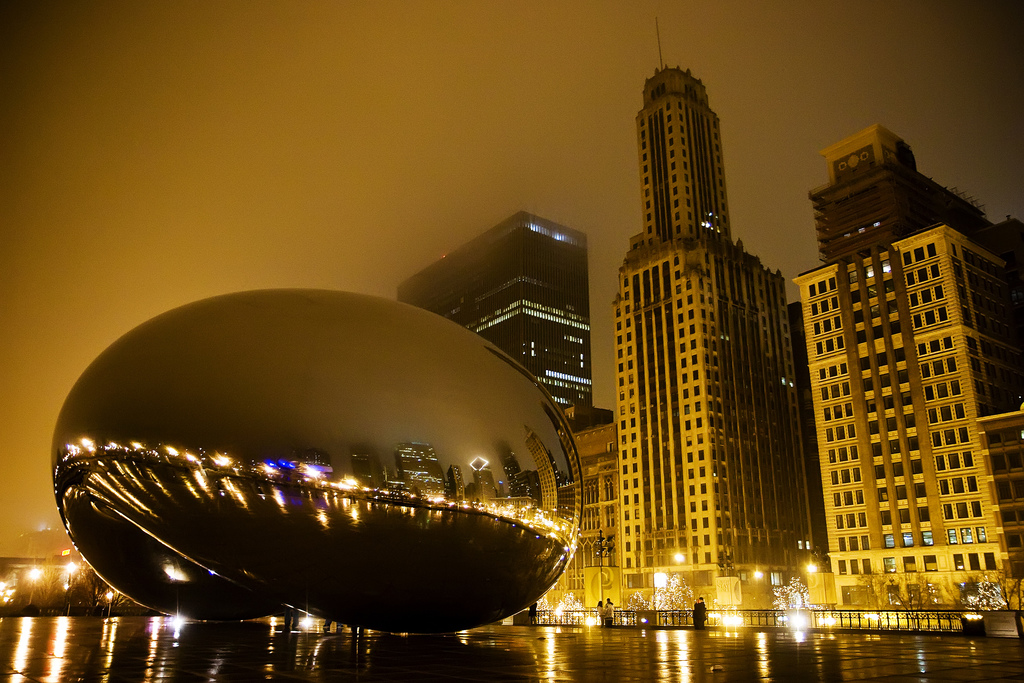
The subdued awe persisted as the music slowly changed from twinkling bells to drones to chant. The mass of people moved as a herd leading to the Bean in Millennium Park. We stopped for several minutes underneath the Bean which amplified the sound and gave us a chance to hear things a little more clearly.

There were certainly a mixture of reactions from passers-by ranging from curious, amused, and bewildered to perplexed, indifferent and even angry. And it was interesting to witness the effect of the music on my own perceptions of people. There was a point at which the music felt like the non-diagetic music to a film montage. As that happened, I caught a glimpse of a cashier at a pharmacy watching us through the window with a glazed look of indifference, and suddenly I was watching the documentary of her life.

We ended soon thereafter at Daley Plaza. I would highly recommend finding (or starting) this event in a city near you. It only happens once a year in each location, so you might have to wait until next year. Don't be skeptical, it's worth it. In fact, I would like to see more such similar performances. Someone should start a boombox ensemble and then encourage composers to write this kind of electroacoustic music.

Here's a video of the Unsilent Night in San Francisco. More videos available on their website.


12.10.2009

Sad Clowns and Blackbirds

Theory: the more complex a piece of art, the longer it takes to penetrate and the longer it takes to fade with repeat experiences. In the history of music, there seems to be a roller-coaster relationship with complexity: things start out simple and get steadily more and more complex until they get so impenetrable that there's a crash: WHEEE! The Baroque was thorny and difficult, and it was to that the Classical was a reaction. The Romantic period period seemed to have a fake crash but was instead redirected into serialism, then total serialism which then spawned a reaction in the hypersimple minimalist style that is decorating so many movie scores these days.

One theory among composers is that writing hypercomplex music means your music (and therefore your soul) will live on forever. They're think they're writing for the future. Unfortunately, there are far too many examples of artists appreciated only well after they died to give this group of misfits hope.

The same theory necessarily applies to live performances, something which I realized watching eighth blackbird's performance of Pierrot Lunaire.

I had been building up to the performance in my mind for several weeks before, listening to the score, explaining the work to my students (music appreciation), and even somehow interviewing 8bb's flutist Tim Munro. I felt ready to take the complexity of the score and make sense of it in a total-brain, dreamlike way.

To me, the music and the text are more than enough to try to make sense of. Already in Schönberg's score, there is tension between foreground and background. Clearly, the "singer" is meant to be the foreground, but the instrumental writing is so dense and ear-catching that I try to fuse the various parts together into some sort of cohesive, symbiotic whole, splitting my conscious attention evenly: 50% singing, 50% instrumental music, and 50% text. That's right, to really absorb the Gestalt requires 150% of conscious thought.

But 8bb doesn't stop there; they add yet another layer of meaning in the choreography of Mark DeChiazza. The movement itself was interesting and eye-catching, but it turned out to be too much so. One could have spent 100% of their attention watching the movement and making sense out of a series of abstract and unrelated relationships.

In talking about the work, DeChiazza seemed overwhelmed by the music, finding it impenetrable. He related stories of burying himself in Expressionist thought and art to try to find a visual language that would correlate to the score. In essence, then, he tried to create a choreography that would be on the same level as the text and music.

This was where he went wrong.

Pierrot Lunaire, for admirers of 20th century music, can stand completely on its own and, even then, merits myriad repeat listenings to penetrate its thick exterior. The goal with the staging, then, should be to make it more immediately accessible to general audiences. While I think DeChiazza succeeded in this to some extent, his success came about through visually distracting the audience from the difficulty of the work rather than highlighting elements in the music or the text.

Less is more.
Musically, 8bb have found a balance with their singer, the incomparable Lucy Shelton. Shelton is a dynamic performer and both demands and merits the audience's full attention. So while she is singing, we don't need a dancer doing twirls in the far background, musicians dramatically sweeping chairs into place, and Pierrot climbing a ladder. We don't need four layers of visuals because we already have four layers of music and an inscrutable text.

Ultimately, it's all about balance. The "volume" of the visuals was too loud for the volume of the music, which could be solved by turning down the visuals (by quieting down the least essential layers: move more slowly or not at all) or turning up the audio. I would do a little of both but making sure that the audio is loud enough to demand attention--though this may go against the birds' time-tested idea of "sound reinforcement" in lieu of "amplification".

information
Adding complexity to complexity creates a work that is both more difficult to penetrate but also one that merits more repeat listenings. The irony is that by adding a visual layer, in an effort to make the work more accessible to some, they made it more complex, therefore less accessible, to others. With repeated experiences, my opinion of the work could change. It was too much information to make sense of in one sitting but will take many, many more before it becomes remotely redundant.

12.05.2009

ex nihilo nihil fit

On 12.3.09, I went to a concert by dal niente, one of the many new music ensembles that have sprung up in the last few years--inspired, no doubt, by the success of eighth blackbird and ICE. Of those, dal niente seems to be the most likely to succeed, combining prodigious talent with a clear sense of identity. The demiurge behind the group, composer Kirsten Brøberg (sic), mostly culls musicians from Northwestern and focuses her programming on the traditions stemming from and interweaving around French spectralists and German timbralists. The two facets seem to have grown simultaneously, like calculus, in those two countries and now have flourished into a mostly Scandinavian tradition.

The concert was expertly performed, highlights being
Gareth Davis on clarinets and J.Austin Wulliman on violin. Davis got in touch with his inner Henry Rollins in the middle of a slew of multiphonics and strange articulations during Lindberg's Ablauf. I enjoyed the insanity that the piece portrayed or, in some cases, induced, but I'm not sure I'd willingly sit through another performance of schizophrenic clarinet violently interrupted by bass drums cleverly situated behind the audience in the choir loft. Effective but unnerving.

Wulliman channeled
Gidon Kremer in his performance of Kaija Saariaho's Calices, the work being a scaled-down version of her violin concerto Graal Théâtre. Though Saariaho uses extensive notations to produce various timbres, overtones, or noises, Wulliman made it seem as effortless as playing Mozart.

The first piece on the program, Jay Alan Yim's
Songs in Memory of a Circle was the most interesting from a composer's perspective. Resembling one of my many unrealized ideas, Yim's piece is a series of pieces able to be played individually or in various simultaneous combinations. Amazingly, the three pieces chosen created a unified whole, a rich tapestry of sound, that actually moved between moments of calm and moments of fluttery activity. The piece was accompanied by a video that was manipulated live. The video was static and ugly compared to the richness in the music, and the manipulation seemed primitive and distracting--something that is not ready for public performance.

The grand finale of the concert was more of an anticlimax. Broberg's Origins received its world premiere. The work was dedicated to Gareth Davis and incorporated him on bass/clarinet in each of the five movements. Each movement involved a different instrumental combination of winds, strings, or mixed ensemble. Compared to the Lindberg work, the piece didn't seem to explore Davis's technical ability to the same extent. Compared to Yim's piece, the textures were less rich and sonorous and so did not hold my attention. It may have been that the work grew out of Broberg's new-found home soil in Minnesota with its deep winters and Scandinavian roots, and my big-city, over-caffeinated ears couldn't shift gears. At the very least, it would have been better situated at the end of the first half; by the end of the concert, our ears had already been worn out and needed something less demanding of our attention.

Overall, though, the ensemble continued to show its mettle and seems durable enough to last for a long while. I look forward to future dal niente concerts, in particular Grisey's
Partiels in the Spring.


Interview: Tim Munro, eighth blackbird

As a preview for the upcoming performance of Schönberg's Pierrot Lunaire by Chicago-based eighth blackbird, I did an interview with the ensemble's rockstar flutist Tim Munro. Tim has become the de facto spokesperson for the group and gives some interesting insights into the work as a whole as well as certain specific songs.

As a teacher of Music Appreciation, I wanted to make this into something that would be both accessible to a wide audience but interesting to people who already know Schönberg's groundbreaking work. It ended up being about 17 minutes long, but it seems to go by quickly.

Originally, this was just to be audio, but the only way to post the audio to this blog was as a video. So I whipped up a little video accompaniment in iMovie. It was in serious danger of being really cheesy, but I think I righted the ship before it was too late.

Let me know what you think.

11.23.2009

music nowish

This is going to be necessarily short. I am only giving myself the time it takes to brew a cuppa—in this case coffee, not tea. Tonight was the concert of MusicNOW, the new music program at the Chicago Symphony Orchestra. The kind of music that it's supposed to be is still in search of a label, but I know one thing it is not: Jazz. Jazz is America's Classical tradition, arising from the folk music into a complex system of structures and form: a musical language. As such, it belongs in the concert hall just as much as so-called Classical music. Not better or worse, it's tradition is merely more recent.

But I had geared myself up for contemporary music and so was disappointed to be presented with Jazz. Not just any Jazz, not daring, contemporary or exciting, this was post-Ellington schmaltz written by an über-talented Brit, Richard Rodney Bennett, with a great deal of craft and nothing to say. It was mind-numbingly uninteresting except, possibly, for the arrangements, which were...um...tight. There were solos, but it was unclear whether they were really improvised or written by the composer.

So I sat fidgety, alternating between listening intently and trying to think of something else. The piece was dripping with sweetness, more of a dessert than appetizer. When it finished, I booed—for the first time in my life. It felt weird and drew nervous glances from my friends, but I was unapologetic: this concert had wasted an hour of my life and I want it back.

The whole experience led me to think that Mark-Anthony Turnage was selfishly presenting one of his heroes, exposing the American audience to someone whom he finds important—but ultimately isn't. Turnage's own piece, Twice Through the Heart, was much more interesting as a study in orchestration and texture. The composer in me got caught up with the variety and flow of colors, so it was only afterward that I realized that the piece is completely disposable, anonymous—“who-cares music.”

Bennett's piece failed the Seinfeld test; that is, I would have rather been watching Seinfeld. Heck, I would have rather been watching Friends. Actually, I wish that it had been Stravinsky's Ebony Concerto. Turnage's piece passed; I enjoyed it but ultimately don't think it's important.

I think we need to draw a line between Gebrauchsmusik and concert music. Concert music demands and merits your entire undivided attention, whereas Gebrachsmusik serves its function and should be judged on how well it does that. The first piece on the program should have been playing some sort of role—it could very well have been a 60s film score—but did not merit the concert treatment.

Thank you for reading. I'm off to finish my piece for this years AIDS Quilt Songbook Concert on December 1. I hope to get the score to the performers tomorrow.


11.18.2009

taking it to the streets

Surreptitiously, the University of Chicago organized a concert featuring Dawn Upshaw, accompanied by an ensemble comprised mostly of hometown heroes 8th blackbird, singing music of Osvaldo Golijov. With such a star-studded performance, you'd expect a sell-out crow, but somehow the word was slow in getting around, so although the concert was full, it wasn't packed--the audience being mostly comprised of aging Hyde Park intellectuals and U of C music students.

The focus of the evening was Golijov's Ayre, an impassioned journey through the folk songs of Pre-Columbian 15th-century Spain. The composer mentions Berio's Folk Songs as one influence, and his own background formed another. Golijov grew up as the only Jewish kid in predominantly Christian Agentina in a household that he has described as "Eastern European." After spending time in Israel, he earned his PhD at UPenn, studying with George Crumb.

His range and depth of influences clearly come across in his music. In fact, it sometimes seems as though the quasi-program in Ayre and other pieces is almost just a pretext to write the music that resonates most deeply with him. Doing so, and by referencing Berio, Golijov garners the approval of academia and gives him license to explore the sounds in the gutters and the streets of the real world.

The result is an otherworldly tapestry, less of a blend, more of a juxtaposition of the religious traditions peacefully coexisting in the times before the much-parodied but still horrendous Spanish Inquisition. Each of the 11 songs is based on an actual folk song; says Golijov: "with a little bend, a melody goes from Jewish to Arab to Christian." This challenges Ms. Upshaw to embody a panoply of characters of different traditions and classes, each with their own vocal style, which she does with great passion and conviction. Her performance brings a theatricality to the work that merges with the intensity of the music, giving the whole a greater emotional impact.

The intensity is the result of confident, chamber-style playing, in which each performer knows his or her role and when their "character" comes to the fore. This is common in eighth blackbird performances; they know the music and each other so well that they start to function more like a rock band than an ensemble. It's a process that requires more rehearsal and more commitment but ends up speaking to a wider audience, one that is used to musicians being more than just musicians, one used to watching performers or, to the extreme, mere entertainers. Classical musicians generally hate to think about presentation, but Eighth blackbird seems comfortable borrowing and incorporating performative, sometimes entertaining elements to augment their musical performances--but never at expense of the music.

To me, as a composer, the most interesting aspect to the work was the instrumentation. The work called for Pierrot ensemble augmented by horn, accordion, guitar, harp, bass, percussion, and laptop. The bulk of the ensemble are members of Chicago-based eighth blackbird who are known for their subtle theatricalization of contemporary music. (They also won a Grammy last year.) In this performance, there was little need for this enhancement except for a few moments in which a particular player became the musical focus for a brief moment: tasteful and appropriate per usual.

The laptop was a bit of a surprise. At the beginning of the work, it added a nearly imperceptible deep background layer, but as the work progressed, it's presence became more and more noticeable--eventually triggering prerecorded percussion loops and samples. It was almost as if Golijov felt that the audience needed to be warmed up to the idea, which, for most of the crowd, was probably true. Although it seemed a bit timid, it ended up taking the focus only when appropriate and then relinquishing it back to Ms. Upshaw. For composers, it's an interesting example to study and learn from; for audiences, it's a good time to get used to the presence of technology in the concert hall.

The experience, as a whole, was highly effective: a soul-stirring, from-the-gut performance from Ms. Upshaw; a tight, rock-star backing band; and a composition that is academically viable, well-crafted, and yet inspired by the music of the People. Golijov does not write music from an Ivory Tower and, in the post-concert conversation, urged the composers at the U of C to do similarly.